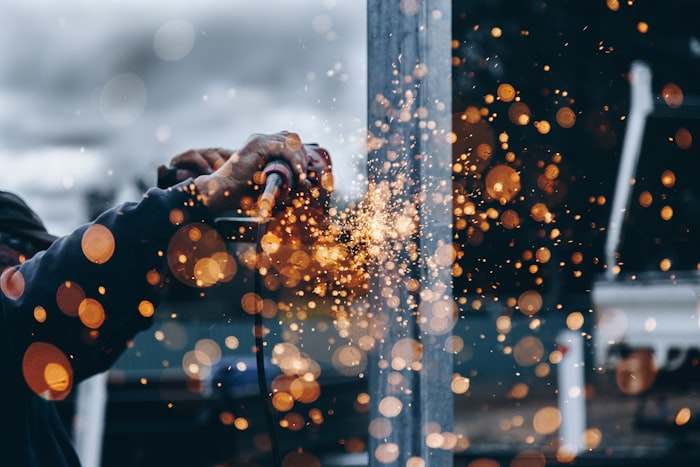
We fabricate steel pipe and tube handrails, guard rails, and stair rail systems for Gulf Coast refineries, warehouses, plants, and commercial construction projects nationwide. Every handrail is built to your exact dimensions, to OSHA 1910.29 and IBC code, and shipped tagged and bundled ready to install.
Here's what we see regularly: a plant or warehouse calls because their facility just got cited by OSHA for non-compliant handrails. The old rail is still there — it just doesn't meet the 2017 revisions to 1910.29 that split the top rail and handrail requirement into separate elements. Now they need everything replaced on a tight timeline.
Or a GC orders a prefab handrail system from a national catalog, gets it to the job site, and finds out the standard post spacing doesn't match the anchor bolt layout in the slab. Now the concrete crew has to core-drill new holes or the rail crew has to field-weld modifications — neither is cheap, and both eat schedule.
Custom fabricated handrails fix both problems at the source. We work from your drawings — or we'll measure the field ourselves if you're in the Gulf Coast region — and we cut, bend, cope, and weld every rail to your exact dimensions. Posts go exactly where your anchor bolts are. Runs are the exact length. Nothing needs field modification.
Our coping machine is the piece of equipment that makes this economical at volume. Coping cuts the end of a pipe or tube to fit cleanly against the face of another pipe — think of the saddle joint at a post-to-top-rail connection. Without a coping machine, that joint gets mitered (two 45° cuts) and welded with a visible V-gap, or it gets a flat-sawn end that doesn't sit flush. With a coped joint, the connection is cleaner, stronger, and requires less weld fill. It's the industry standard for quality handrail work, and we produce it fast because we have the right equipment.
Not every handrail application is the same. Here's how we think about material and configuration selection — the same way we'd talk through it on a quote call.
The workhorse of plant fall protection. Fabricated from 1.5" or 2" nominal Schedule 40 ASTM A53 black pipe or ASTM A500 structural tube. Used on catwalks, platforms, mezzanines, loading dock edges, and equipment access areas throughout refineries, chemical plants, and warehouses.
Finish: Prime paint (red oxide or gray) standard. Safety yellow powder coat available for high-visibility areas. Hot-dip galvanize for outdoor and coastal installations.
Architectural profile for commercial construction, office buildings, retail, and food processing. 1.5×1.5 or 2×2 inch 11-gauge or 14-gauge ASTM A500 Grade B square tube gives a cleaner look and is easier to grind smooth for painted finishes. Increasingly specified by architects on commercial projects where the rail will be visible.
IBC 1015 compliant for commercial occupancies — 42" guardrail height, 36" for residential. Graspable handrail profile 1.25"–2" diameter required by IBC 1014.
ADA 4.8 requires handrails on both sides of stairs with 12" horizontal extensions beyond the top and bottom risers, graspable profile between 1.25" and 2" OD, and continuous surface with no obstructions. We fabricate ADA handrails from 1.5" Schedule 40 pipe or 1.5" square tube with smooth welded returns.
Common for commercial building renovations, ramp additions, and public facility upgrades requiring ADA compliance documentation.
Hot-dip galvanized handrail systems for outdoor installations, Gulf Coast coastal environments, chemical-exposure areas, and any application where carbon steel prime coat won't last. The galvanized coating — ASTM A123 for structural, ASTM A153 for hardware — provides 50+ years of corrosion protection in most environments compared to 5–10 years for paint alone.
304 stainless is the standard for most stainless handrail applications — pharmaceutical, food processing, clean rooms, and architectural. 304 (18-8 composition) resists most corrosive environments and polishes to a clean surface finish. TIG welded to AWS D1.6 stainless steel welding standard. Available in brushed #4 or mirror #8 finish.
316L (low carbon, with molybdenum) is the correct choice for marine environments, seawater exposure, food processing, and pharmaceutical. The molybdenum addition dramatically increases resistance to chloride pitting — critical for Gulf Coast coastal facilities and any environment with cleaning chemicals or salt air. Electropolish available for sanitary applications.
Every type of facility that needs compliant fall protection — and the specific reason handrails are a constant, recurring need at each one.
A refinery or chemical plant has miles of handrail — platforms, catwalks, pipe rack access, unit structures, tank access stairs, and process building stairs. Corrosion, impact damage, and plant expansions create constant handrail replacement and addition work. Turnaround shutdowns compress the timeline — we prioritize turnaround orders.
Our Baldwin County location puts us within driving distance of Mobile Bay, Saraland, and Baton Rouge corridor plants. We deliver local on flatbed — no freight add.
Mezzanine guard rail, stair handrails, dock edge protection, rack aisle barriers — every warehouse has these. As distribution centers expand and add mezzanine levels, handrail requirements grow with them. OSHA inspections in warehousing are frequent, and mezzanine fall protection citations are common. We've fabricated guard rail systems for single-mezzanine additions and full multi-level distribution center builds.
General contractors building commercial offices, retail centers, hotels, and public buildings need fabricated stair rail systems and guard rail on every project. The work is predictable — every multi-story building needs compliant stair handrail. Our quote-to-ship timeline fits standard commercial construction schedules. We become the standing handrail fab supplier for GCs who work in the Gulf Coast region.
316L stainless with passivation and crevice-free welds is the only acceptable handrail for environments subject to USDA or FDA inspection. Bacteria harborage in weld gaps, crevices, and rough surfaces is a critical compliance issue. We TIG weld full-penetration joints, grind smooth, passivate per ASTM A967, and provide material certifications with every stainless order.
Baldwin County sits adjacent to one of the strongest shipbuilding corridors in the country — Austal USA in Mobile, NASSCO at Mobile, and the broader Gulf Coast maritime industry. Aluminum and stainless handrails for vessels, dock facilities, and shipyard structures are a natural market for our shop. Salt air requires either 316L stainless or hot-dip galvanized — we fabricate both.
Maintenance contractors and plant turnaround specialists who manage ongoing facility compliance at refineries, chemical plants, and industrial sites are among our best customers. They need a reliable fab shop that can price quickly, commit to a delivery date, and produce handrail to code without requiring a drawing review on every order. We've built standing accounts with several Gulf Coast maintenance contractors for exactly this reason.
We show prices because buyers who can't get a ballpark online move on. These numbers are real — quoted from actual material costs, not a marketing figure. Final price is from your dimensions.
| Handrail Type | Material / Grade | Price Per Linear Foot | Typical Order | Lead Time |
|---|---|---|---|---|
| OSHA Pipe Guard Rail | A53 carbon steel, prime paint | $65–$85/ft | $2,500–$8,000 | 2–3 weeks |
| Square Tube Guard Rail | A500 Gr B, prime paint | $75–$95/ft | $3,000–$12,000 | 2–3 weeks |
| ADA Stair Handrail | Carbon steel or 304SS | $85–$120/ft | $2,000–$8,000 | 2–3 weeks |
| Galvanized Guard Rail | A53 + ASTM A123 HDG | $95–$130/ft | $4,000–$18,000 | 3–4 weeks |
| 304 Stainless Handrail | 304/304L, brushed or polished | $110–$160/ft | $5,000–$22,000 | 3–5 weeks |
| 316L Marine Grade | 316L, passivated, TIG welded | $140–$200/ft | $6,000–$28,000 | 4–6 weeks |
| Full Stair Rail System | Carbon steel or galvanized | $120–$180/ft | $5,000–$20,000 | 3–4 weeks |
We give you a fixed price from your drawings and we commit to a ship date. Nothing changes unless the scope changes.
Drawings, dimensions, site sketch, or a call. We'll take any starting point.
Detailed pricing within 24 hours. Price is locked — not an estimate.
We produce fabrication drawings for your review before we cut metal.
AWS certified welders. Coping machine for clean joints. QC inspection before shipping.
Bundled, tagged, and shipped nationwide. Gulf Coast direct delivery available.
Send us your project details below. Fixed price, committed schedule, no games. If you need to talk through the project first, call (251) 776-4337 — someone at the shop will answer.
Response within 24 hours — no obligation
Secure. No spam. 24-hour response guaranteed.
Carbon steel pipe guard rail in prime paint runs $65–$85 per linear foot fabricated. Square tube runs a bit more. Galvanized adds roughly $25–$40/ft. Stainless 304 runs $110–$160/ft. 316L marine grade is $140–$200/ft. Most plant orders total $3,000–$20,000. We quote from your dimensions within 24 hours — no charge to quote.
29 CFR 1910.29 covers handrails in general industry. 1926.502 covers construction. Key numbers: 42" top rail, 21" mid-rail, posts max 8 feet apart, 200-lb point load in any direction. Stair handrails must be separate graspable elements at 30"–38" above stair tread — that requirement changed in the January 2017 revision.
Fabrication itself doesn't require a permit — that's a shop process. Installing in a building typically does require a permit in most jurisdictions, especially for commercial occupancies under IBC. The building permit and inspection is the installer's responsibility. We provide shop drawings and mill certs to support your permit package.
A guard rail (guardrail) is the protective barrier system at an elevated edge — its job is to prevent falls. A handrail is the graspable element alongside a stairway or ramp — its job is to provide support while climbing or descending. OSHA 1910.29 and IBC 1015 both require guardrails at unprotected edges. IBC 1014 and OSHA 1910.29 require handrails on stairs. On many stair systems you need both: a guardrail at the open side and a graspable handrail to hold.
Specify galvanized for: outdoor installations, Gulf Coast coastal environments, facilities with moisture or chemical exposure, and anywhere the paint system is hard to maintain. Hot-dip galvanized (ASTM A123) lasts 50+ years in most environments. Paint systems on carbon steel in industrial environments typically need recoating every 5–10 years. The lifecycle cost of galvanized is almost always lower even though the upfront cost is higher.
Stainless when: the environment involves food contact, pharmaceutical production, or USDA/FDA inspection. Also specify stainless when aesthetics matter — galvanized has a spangle appearance that doesn't suit architectural applications. 304 is right for most stainless handrail work. Upgrade to 316L for marine environments, seawater exposure, or chemical environments with chlorides — the molybdenum in 316 resists chloride pitting that 304 can't handle.
Carbon steel prime paint: 2–3 weeks. Galvanized: 3–4 weeks (1 week added for HDG processing). 304 stainless: 3–5 weeks. 316L stainless: 4–6 weeks. Rush available for plant turnarounds — call first to confirm capacity. Large multi-run systems (1,000+ linear feet) may run 6–8 weeks depending on our current schedule.
At minimum: total linear feet needed, material (carbon/galvanized/stainless), and delivery location. With that we can give you a budget number. For a fixed quote we need your dimensions — run lengths, post spacing, heights, and any non-standard features. Drawings are best. A marked-up site sketch or a list of dimensions works. We've worked from phone descriptions too — it just takes more back-and-forth.
Every product we fabricate is built in the same Baldwin County shop, by the same AWS-certified welders, to the same quality standard. Order multiple products together for combined lead times and volume pricing.
Send your dimensions or call the shop. Fixed price, 24-hour response, ships nationwide.